
Your Indoor Air Quality Does Not Have to Suffer: AC and Heat Pump Tips During B.C. Wildfire Smoke
July 10, 2026
Wildfire smoke is once again affecting communities across parts of British Columbia.
At the time of writing, a provincial air quality warning issued on July 9, 2026, included communities in the East Columbia, northern East Kootenay, Fraser Canyon, Nicola, Shuswap and South Thompson regions. Smoke conditions can change quickly as fires, winds and weather patterns shift.
Even when Metro Vancouver or the Fraser Valley is not directly under an air quality warning, wildfire smoke can travel long distances. Residents should continue monitoring provincial air quality warnings, the Air Quality Health Index and Metro Vancouver air quality information.
West Coast Geothermal would like to remind British Columbians that your indoor air quality does not have to suffer unnecessarily during wildfire smoke events.
A properly operating heat pump, central air-conditioning system, furnace, fan-coil unit or other forced-air HVAC system can help maintain a cool indoor environment and repeatedly circulate air through a suitable filter.
The objective is not necessarily to bring more outdoor air inside while it is smoky. The objective is to achieve multiple clean-air changes per hour by repeatedly filtering and recirculating indoor air.
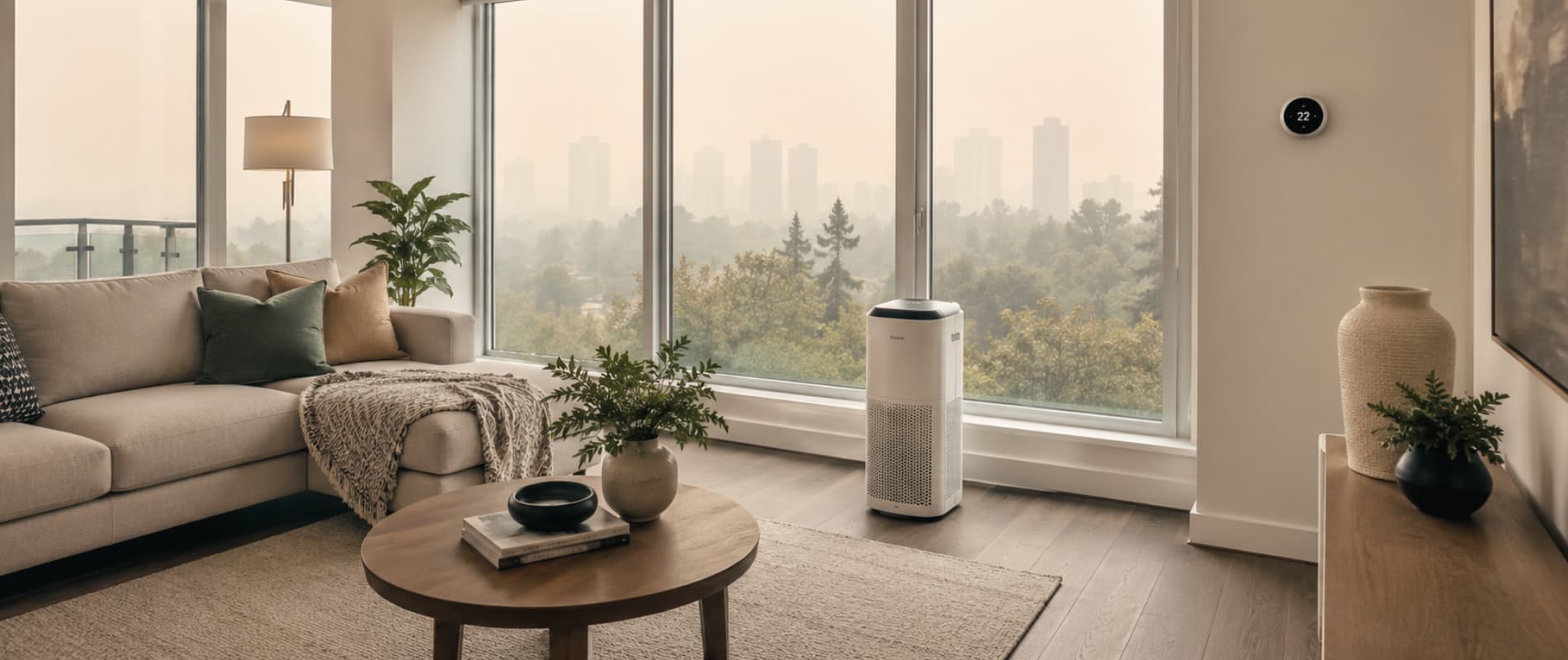
TL;DR: What to Do During Wildfire Smoke
- Inspect, clean or replace your HVAC filter.
- Use the highest-efficiency filter your system can safely accommodate.
- Consider setting the fan to ON or CIRCULATE so air passes through the filter more frequently.
- Keep windows and exterior doors closed when outdoor air is smoky.
- Set systems with outdoor-air controls to recirculation where appropriate.
- Use a properly sized portable HEPA air cleaner for additional filtration.
- Aim for multiple filtered or equivalent clean-air changes per hour.
- Keep supply vents and return-air grilles clear.
- Limit candles, smoking, frying and other indoor particle sources.
- Monitor local air quality announcements and prioritize staying cool during extreme heat.
- Arrange professional service if your system has weak airflow, unusual noises, leaks or poor cooling.
Why Wildfire Smoke Affects Indoor Air Quality
Wildfire smoke contains gases and extremely small airborne particles. Fine particulate matter, commonly called PM2.5, is considered the main health concern associated with wildfire smoke because the particles can travel deep into the lungs.
Smoke particles can enter a home or building through:
- Open windows and doors
- Outdoor-air intakes
- Hallways and common areas
- Bathroom and kitchen exhaust replacement air
- Small openings in the building envelope
- Poorly sealed ventilation or filtration systems
Closing the windows can reduce smoke infiltration, but it will not necessarily eliminate it.
That is why cooling, air circulation and filtration need to work together.
1. Clean or Replace the HVAC Filter
Whether your home uses a geothermal heat pump, water-source heat pump, air-source heat pump, central air conditioner, furnace or another forced-air system, start by checking the filter.
The filter may collect:
- Dust
- Pet hair
- Fibres
- Pollen
- Fine airborne particles
- Particulate from wildfire smoke
During prolonged smoke events, filters can become loaded more quickly than they would under normal conditions.
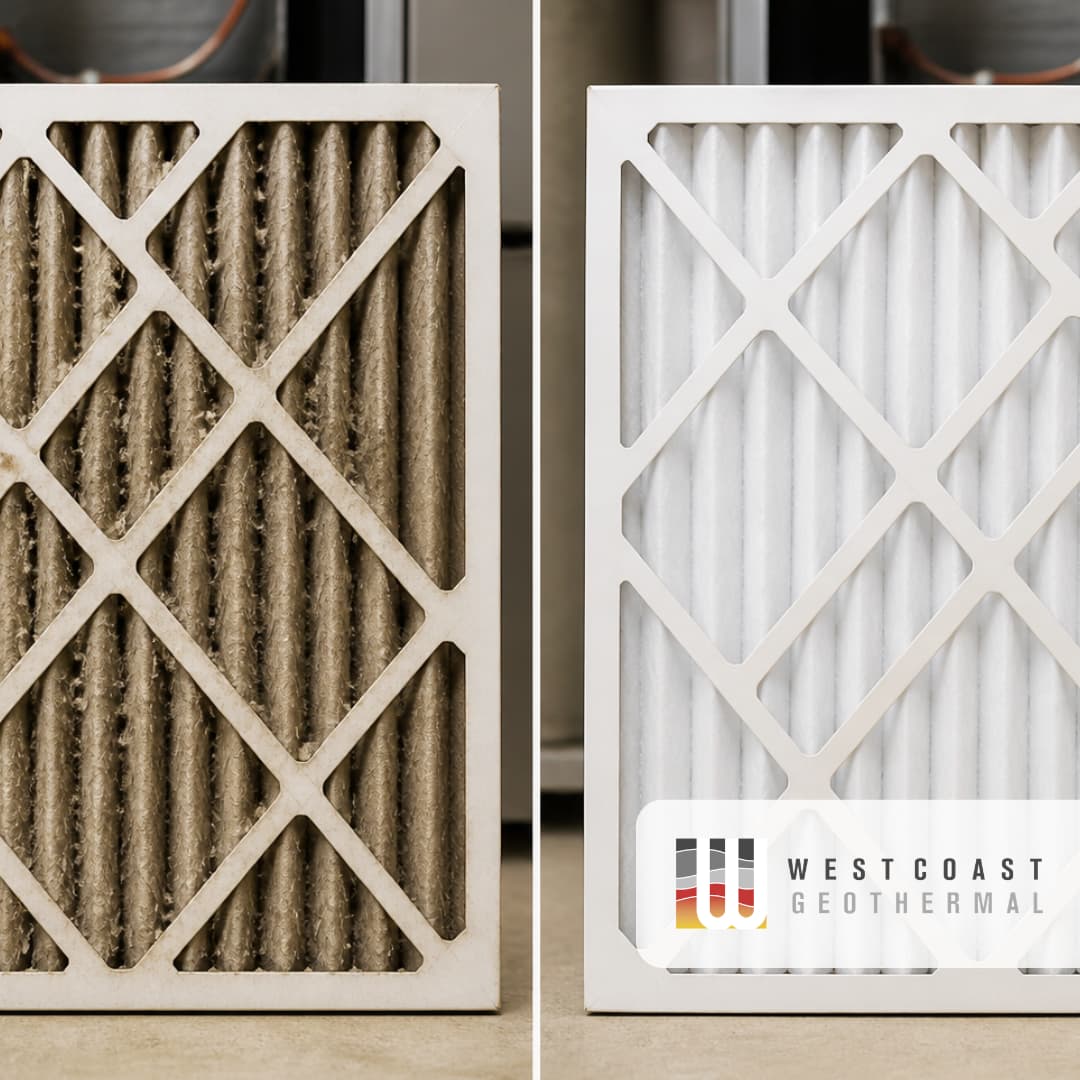
A clogged filter restricts airflow. This can make it harder for your air conditioner or heat pump to cool the space and reduces the amount of air being passed through the filter.
During smoky conditions:
- Inspect the filter more frequently.
- Replace disposable filters that are dirty, damaged or overdue.
- Clean reusable filters according to the manufacturer’s instructions.
- Allow washable filters to dry fully before reinstalling them.
- Make sure the filter fits correctly without large gaps around it.
- Install the filter with the airflow arrow pointing in the proper direction.
B.C. and federal guidance recommend using a clean, good-quality filter and replacing filters more frequently when wildfire smoke causes them to become clogged.
2. Use the Best Filter Your System Can Handle
Higher-efficiency filters can capture more fine particles, but the filter must be compatible with the equipment.
MERV is a rating used to describe the particle-capturing performance of an HVAC filter. MERV 13 or higher filtration can capture more of the fine particulate associated with wildfire smoke than many basic filters.
However, not every system is designed to operate with a highly restrictive filter.
This is particularly important for:
- Older central air-conditioning systems
- Older furnaces
- In-suite water-source heat pumps
- Compact condo fan-coil systems
- Equipment with small filter racks
- Systems already experiencing airflow problems
Installing a filter that is too restrictive can reduce airflow and negatively affect system performance.
Use the highest-quality filter recommended by the equipment manufacturer or an HVAC professional. Do not automatically insert the highest-rated filter you can find without confirming that the system can accommodate it.
3. Set the Fan to “ON” or “CIRCULATE”
Most thermostats include several fan settings:
- AUTO: The fan runs mainly when the equipment is actively heating or cooling.
- ON: The fan operates continuously.
- CIRCULATE: The fan runs periodically, even when there is no active heating or cooling call.
During wildfire smoke, setting a compatible system to ON or CIRCULATE can help because indoor air passes through the filter more frequently.
This may apply to:
- Central air conditioners
- Ducted heat pumps
- Forced-air furnaces
- Geothermal heat pumps
- Water-source heat pumps
- Some in-suite fan-coil systems
The fan does not remove smoke by itself. Its value comes from moving air through a clean and effective filter.
Continuous fan operation may:
- Increase filtration
- Improve air mixing
- Help reduce pockets of stagnant air
- Use additional electricity
- Cause the filter to become dirty faster
Check the filter regularly and follow the operating recommendations for your specific equipment.
4. Aim for Multiple Clean-Air Changes Per Hour
West Coast Geothermal encourages repeated filtration throughout the day.
In technical terms, the objective is to provide multiple equivalent clean-air changes per hour. This means that an amount of filtered air equal to the volume of the room is delivered several times each hour.
This clean air can be provided through:
- A central HVAC filter
- A heat pump or air-conditioning system operating in recirculation
- A portable HEPA air cleaner
- A combination of central and portable filtration
Health Canada recommends choosing portable air cleaners with a smoke Clean Air Delivery Rate capable of filtering at least two to three times the room volume per hour. Larger rooms, open floor plans and heavily affected spaces may require a larger unit or more than one air cleaner.
For example, a portable air cleaner should not be selected only because it fits the budget or fits on a table. It must also be large enough to process the air volume of the room.
Clean-Air Changes Are Not the Same as Outdoor-Air Changes
This distinction is important.
During normal conditions, outdoor-air ventilation helps dilute indoor contaminants and control carbon dioxide, moisture and odours.
During a wildfire smoke event, however, increasing unfiltered outdoor-air intake may bring additional smoke particles inside.
Health Canada recommends recirculating indoor air when outdoor conditions are poor and bringing in fresh air when the smoke plume clears or outdoor conditions improve.
5. Use Recirculation Where Appropriate
Some central HVAC and ventilation systems can be switched between:
- Outdoor-air intake
- Mixed outdoor and return air
- Indoor-air recirculation
When smoke levels outdoors are high, recirculation can reduce the amount of smoky air deliberately drawn into the building.
This setting may be controlled by:
- The homeowner
- A thermostat
- A building automation system
- A strata or property manager
- A commercial building operator
Condo residents should not independently shut down common ventilation equipment or modify central building controls.
Many condo heat pumps only recirculate air within the suite. Fresh air may be provided separately through a central building system, hallway pressurization, an HRV, an ERV or another dedicated outdoor-air system.
Speak with the strata council, property manager or building operator if you are unsure how fresh air enters your suite.
6. Keep Windows and Exterior Doors Closed
When outdoor air quality is poor, keep windows and exterior doors closed as much as practical.
Use your heat pump or air-conditioning system to maintain a comfortable indoor temperature rather than opening windows for cooling.
When extreme heat and wildfire smoke occur at the same time, health authorities advise prioritizing staying cool. If your home becomes dangerously warm, find a cleaner, air-conditioned location such as a library, community centre or shopping centre.
7. Add a Portable HEPA Air Cleaner
A portable HEPA air cleaner can supplement the filtration provided by a heat pump or central AC system.
Place the air cleaner in a room where people spend the most time, such as:
- A bedroom
- A living room
- A home office
- A room used by someone with respiratory or cardiac concerns
Choose a unit that:
- Uses true HEPA filtration
- Has a smoke CADR appropriate for the room size
- Can be operated continuously
- Does not intentionally produce ozone
- Has readily available replacement filters
Portable air cleaners can be especially valuable when the existing HVAC system has limited filtration capacity or cannot accommodate a higher-rated filter.
8. Create a Cleaner-Air Room
It may not be practical to filter an entire house or condo equally.
Instead, choose one room as a cleaner-air space.
A good cleaner-air room should have:
- Closed windows
- Limited exterior door traffic
- A portable HEPA air cleaner
- Cooling or air conditioning
- Minimal cooking, candles or other particle sources
- Enough room for the people who need to use it
Keep the door closed where practical and operate the air cleaner continuously during smoky periods.
9. Reduce Indoor Sources of Particulate
Outdoor wildfire smoke is not the only source of indoor particles.
During poor air quality, limit activities that create additional smoke or particulate indoors, including:
- Smoking or vaping
- Burning candles
- Burning incense
- Using wood-burning fireplaces
- Frying or broiling food at high temperatures
- Using aerosol sprays
- Vacuuming without effective filtration
Kitchen and bathroom exhaust fans should still be used when required for safety, moisture or cooking, but avoid leaving them running unnecessarily. Exhausting indoor air can draw unfiltered outdoor air into the building through other openings. Health Canada recommends limiting unnecessary exhaust-fan use during smoke events.
10. Keep HVAC Airflow Clear
Good filtration depends on good airflow.
Check that:
- Return-air grilles are not blocked.
- Supply registers remain open.
- Furniture is not obstructing vents.
- The filter is properly installed.
- Mechanical closets are not packed with stored belongings.
- Condo heat pump access panels are unobstructed.
- Outdoor equipment is free of debris where applicable.
Do not close multiple supply vents in an attempt to force more air into one room. This can increase system pressure and reduce overall performance.
11. Know When the System Needs Service
Contact a qualified service provider if the heat pump, central AC system or fan-coil unit is:
- Producing weak airflow
- Not maintaining the set temperature
- Running continuously without cooling properly
- Leaking water
- Making unusual noises
- Producing unusual odours
- Frequently turning on and off
- Tripping a breaker
- Displaying an error code
- Overdue for maintenance
Changing the filter may improve airflow, but it will not correct refrigerant problems, water-loop issues, failed motors, blocked coils, drainage problems or control failures.
Monitor Current B.C. Air Quality Conditions
Conditions can change significantly throughout the day.
Monitor information from:
- B.C. Air Quality Warnings
- The Air Quality Health Index
- Metro Vancouver Air Quality
- Environment and Climate Change Canada smoke forecasts
- Fraser Health
- Interior Health
- Your local municipality or regional district
- Your strata council or property manager
The Province’s July 9, 2026 warning advised residents to keep windows and doors closed, use clean filtration, use certified portable air cleaners and seek cleaner air-conditioned spaces when a home becomes smoky or hot.
Your Indoor Air Quality Does Not Have to Suffer
Wildfire smoke can create difficult outdoor conditions, but there are practical ways to improve the air inside your home, condo or business.
West Coast Geothermal recommends:
- Maintaining a clean HVAC filter.
- Using the best filtration the system can safely accommodate.
- Operating the fan often enough to repeatedly filter indoor air.
- Aiming for multiple equivalent clean-air changes per hour.
- Using portable HEPA filtration where needed.
- Keeping windows closed when outdoor smoke is elevated.
- Setting compatible systems to recirculation.
- Keeping the home safely cool.
- Monitoring local air quality information.
- Servicing cooling equipment that is not operating properly.
West Coast Geothermal services geothermal heat pumps, water-source heat pumps, central air-conditioning systems and related heating and cooling equipment throughout Metro Vancouver, the Lower Mainland and the Fraser Valley.
If your system is not cooling properly, has weak airflow or is overdue for maintenance, have it inspected before the next period of extreme heat or wildfire smoke.