
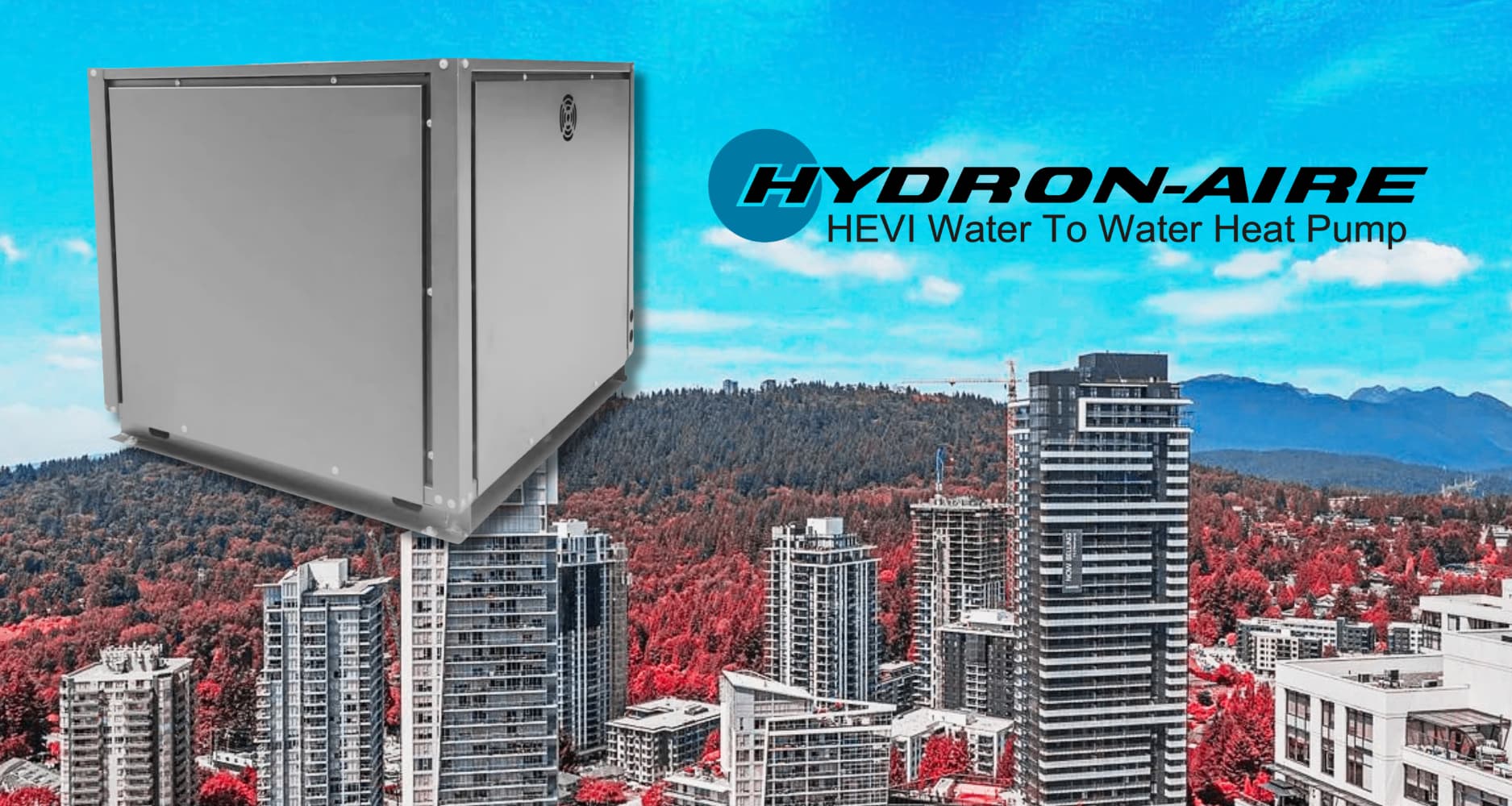
A More Advanced Water-to-Water Heat Pump Replacement Option: HEVI
September 17, 2026
When an older water-to-water heat pump fails, replacing it doesn’t always mean finding the closest modern version of the equipment that was originally installed.
West Coast Geothermal has added the Hydron-Aire HEVI variable-speed water-to-water heat pump to the replacement options we can evaluate for suitable geothermal, condo, strata, hydronic, and shared-loop systems.

Why is that useful?
Because some older systems deserve a closer look before another piece of equipment is dropped into the same spot.
Rather than simply replacing an aging fixed-speed unit with something similar, the HEVI gives us another option to consider based on how the system actually operates: its water temperatures, flow rates, heating and cooling requirements, electrical service, controls, and building-loop conditions.
And those details matter.
A proper water-to-water heat pump replacement involves much more than matching the BTU rating printed on the old equipment. Two heat pumps can look comparable on paper but perform very differently once they’re connected to an existing system.
What is a water-to-water heat pump?
A water-to-water heat pump transfers heat between two water circuits.
On the source side, the heat pump connects to a water loop. In a geothermal installation, that might be a ground loop. In a condo, strata, or commercial building, it could be a shared building water loop serving multiple suites or zones.
On the load side, the heat pump produces heated or chilled water. That water can then serve hydronic equipment, fan coils, radiant systems, or other water-based heating and cooling equipment.
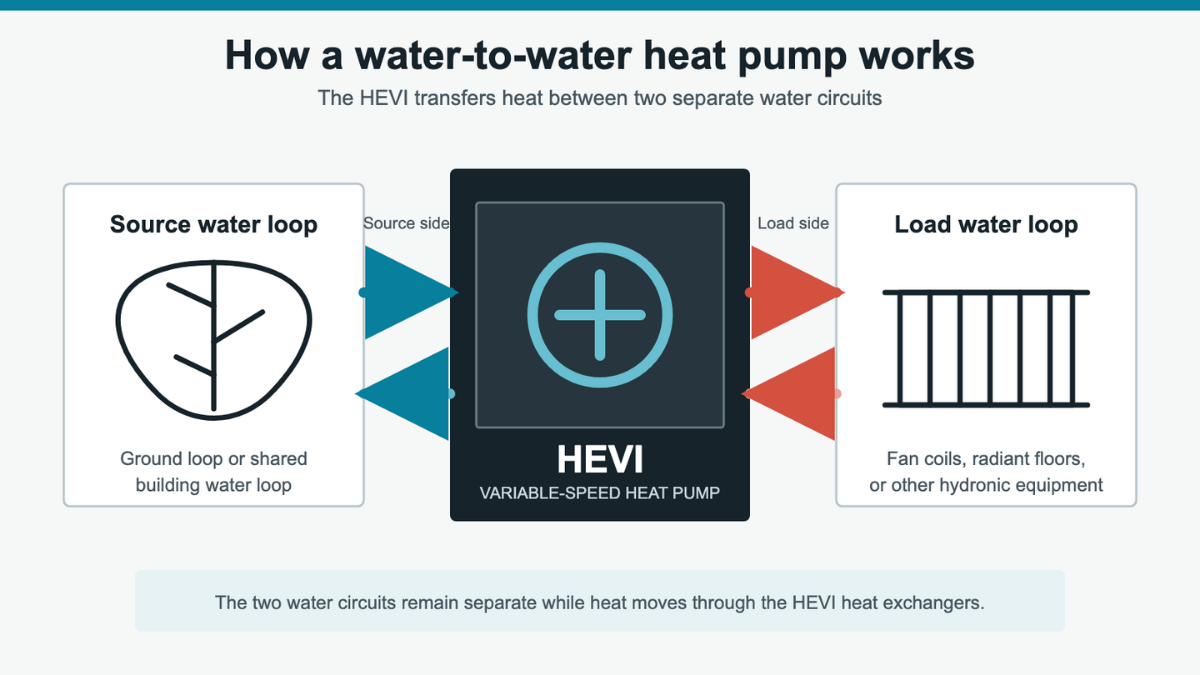
This is why replacing one requires more than checking the capacity of the old unit.
Flow rates, operating temperatures, pressure drops, piping arrangements, and controls all affect how the replacement will perform. If those requirements don’t line up with the existing system, even a heat pump with the “right” capacity may not be the right fit.
Why variable-speed operation matters
One of the HEVI’s most notable features is its variable-speed compressor and inverter control.
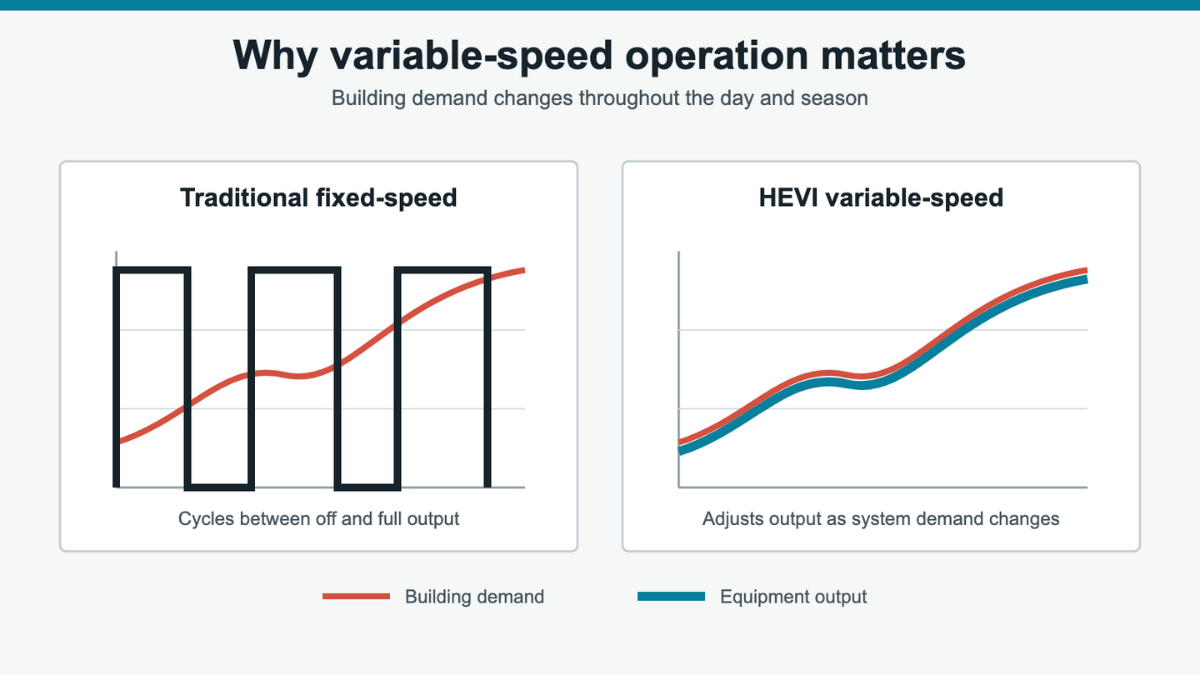
A traditional fixed-speed heat pump generally turns on and operates at full output whenever heating or cooling is needed. Variable-speed equipment can adjust its operation as demand changes.
That makes sense when you consider how buildings actually operate.
Your home or building rarely needs maximum heating or cooling all day. Demand changes with outdoor temperatures, occupancy, solar gain, and other conditions.
Variable-speed operation gives the equipment more flexibility to respond to those changing loads.
According to Hydron-Aire’s specifications, the HEVI also includes:
- Variable-speed compressor
- Brazed plate heat exchangers
- Insulated cabinet
- Carel control system and inverter
- Loop- and load-side pump power connections
- Load-side variable-speed pump control
- Built-in outdoor reset control
- Leaving or return water temperature control
- Onboard diagnostics
Those controls can be particularly useful in water-to-water applications because the heat pump isn’t operating by itself. It’s one part of a larger hydronic system, and how it interacts with that system matters.
Available HEVI water-to-water heat pump sizes
Hydron-Aire currently lists three HEVI water-to-water models: 040, 060, and 080.
| Model | Heating capacity at 40/45°C load water and 10/5°C source water | Cooling capacity at 12/7°C load water and 30/35°C source water | Sound level |
|---|---|---|---|
| HEVIWWHP040 | 47,768 BTU/h | 40,944 BTU/h | 48 dB(A) |
| HEVIWWHP060 | 71,652 BTU/h | 61,416 BTU/h | 48 dB(A) |
| HEVIWWHP080 | 95,536 BTU/h | 81,888 BTU/h | 52 dB(A) |
The heating ratings above are based on load-side water temperatures of 40°C entering and 45°C leaving, with source-side water at 10°C entering and 5°C leaving.
For cooling, the ratings use load-side water at 12°C entering and 7°C leaving, with source-side water at 30°C entering and 35°C leaving.
All three units use R32 refrigerant and are single-phase. The 040 and 060 models have 1-inch water connections, while the larger 080 uses 1-1/4-inch connections.
Maximum current is listed at 23 amps for the 040, 28 amps for the 060, and 39 amps for the 080.
These details might seem technical, but they’re important. Electrical capacity, water flow, piping, and operating conditions all need to work together, which is why we evaluate the complete system before recommending a replacement.
Heat pump efficiency depends on actual water temperatures
Here’s where water-to-water heat pump comparisons can get misleading.
There isn’t one COP or efficiency number that tells you exactly how a heat pump will perform in every installation.
Performance changes with the water temperatures on both sides of the system and whether the source side contains water or glycol. Hydron-Aire’s HEVI specifications provide a good example.
At load-water temperatures of 40°C entering and 45°C leaving, with source water at 10°C entering and 5°C leaving, the listed heating COP is 4.4.
Lower the load-water temperatures to 30°C entering and 35°C leaving under the same source-water conditions, and the listed COP increases to 5.81.
Raise the load-water temperatures to 50°C entering and 55°C leaving, and the listed COP drops to 3.52.
That’s a substantial difference.
It also shows why looking at one efficiency number on a specification sheet doesn’t tell the whole story. You need to know the operating conditions under which that number was measured and whether those conditions resemble your actual system.
In general, lower-temperature hydronic systems are easier for a heat pump to serve efficiently. Producing hotter water makes the refrigeration system work harder.
So during a replacement assessment, we’re not simply asking:
What’s the COP?
We’re asking:
How will this heat pump perform at the temperatures and flow rates this particular system actually needs?
That’s a much more useful question.
When is the HEVI water-to-water heat pump worth considering?
The HEVI may be a good replacement option when an existing water-to-water heat pump is aging, has failed, or is becoming difficult or expensive to repair.
It can be considered for geothermal systems, hydronic heating and cooling systems, and some condo or strata buildings with shared water loops. Its variable-speed operation and advanced controls may also make it a useful alternative to replacing an older fixed-speed unit with similar equipment.
However, the HEVI is not automatically suitable for every system. Before recommending it, West Coast Geothermal reviews the existing water loop, pumps, piping, electrical service, water temperatures, flow requirements, controls, available space, and the building’s heating and cooling needs.
Looking at the complete system helps us select equipment that will operate properly, provide reliable comfort, and avoid unnecessary service problems.
How West Coast Geothermal approaches water-to-water heat pump replacement
When we’re called to look at an aging or failed water-to-water heat pump, we start with the system, not the equipment brochure.
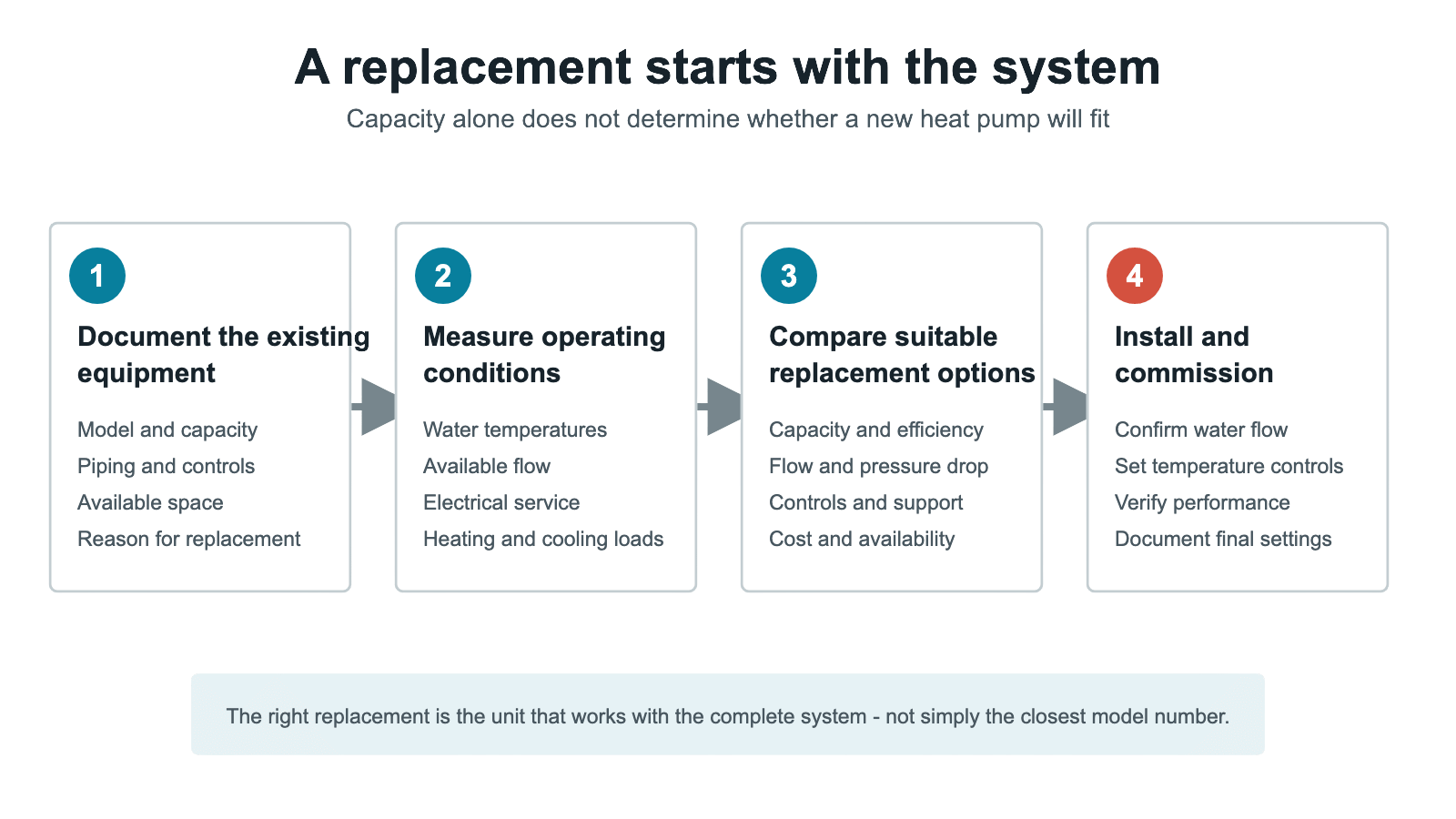
First, we want to understand what’s already there and how it operates.
- What equipment is installed now?
- Why is replacement being considered?
- What heating and cooling loads need to be served?
- What temperatures and water flow does the system require?
- Is the electrical service adequate? How is everything controlled?
- And is there enough physical space for the replacement equipment?
Just as importantly, we look for problems elsewhere in the system that may have contributed to the original equipment failing.
In condo and strata properties, things can become even more involved. Equipment inside an individual suite may interact with a shared building loop, and changes can involve the owner, strata council, property manager, or building mechanical contractor.
That’s why equipment selection comes after understanding the system.
The Hydron-Aire HEVI gives West Coast Geothermal another water-to-water heat pump option to evaluate. Its variable-speed compressor, inverter controls, water-temperature control, and onboard diagnostics make it an interesting alternative when replacing older equipment.
Sometimes the HEVI may be a strong fit. In another system, different equipment may make more sense.
Our goal isn’t to sell a particular box. It’s to find equipment that works properly with the system that’s already there.
If you have an aging water-to-water heat pump, have received a high replacement quote, or have been told your existing equipment is obsolete or difficult to replace, West Coast Geothermal can provide a second opinion and evaluate the available replacement options.
Frequently Asked Questions
Is the HEVI a geothermal heat pump?
The HEVI is a water-to-water heat pump. It can be used as part of a geothermal system when its capacity, flow requirements, operating temperatures, and other specifications are appropriate for the application.
Can the HEVI be used in a condo or strata building?
Potentially, yes. Water-to-water heat pumps can work with shared building loops and hydronic systems found in some condo, strata, and commercial properties.
The existing building system should be evaluated before determining whether a particular HEVI model is suitable.
West Coast Geothermal works with condo owners, strata councils, and property managers throughout British Columbia to assess existing equipment, building-loop conditions, and suitable replacement options.
Learn more about our condo heat pump replacement services.
Why does variable speed matter?
Variable-speed operation allows the heat pump to adjust its operation as heating or cooling demand changes instead of operating at only one fixed output.
That provides more flexibility when matching equipment operation to changing system loads.
Can the HEVI replace any old water-to-water heat pump?
No. Replacement equipment needs to be selected according to heating and cooling capacity, water temperatures, flow rates, electrical requirements, controls, piping, and available installation space.
West Coast Geothermal reviews these factors before recommending replacement equipment.
What refrigerant does the HEVI use?
The current HEVI 040, 060, and 080 specifications list R32 refrigerant.
R32 is a modern heat-pump refrigerant with no ozone-depletion potential and a lower global-warming potential than some older refrigerants commonly used in HVAC equipment. It is classified as an A2L refrigerant, meaning it has lower toxicity but is mildly flammable and requires equipment and installation practices designed specifically for its safe use.
British Columbia’s refrigeration regulations recognize A2L refrigerants. As with any heat pump, compliance depends on the equipment’s Canadian certification and how it is installed, including the refrigerant charge, mechanical-room conditions, electrical work, ventilation, clearances, and manufacturer requirements.
West Coast Geothermal reviews these requirements as part of the equipment-selection and installation process.
What HEVI sizes are available?
The current Hydron-Aire specification sheet lists three models:
HEVIWWHP040, HEVIWWHP060, and HEVIWWHP080, with nominal heating outputs of approximately 14 kW, 21 kW, and 28 kW respectively under the manufacturer’s stated rating conditions.
Does the HEVI have a warranty?
West Coast Geothermal currently quotes the HEVI with a 5-year parts warranty.
Warranty coverage and terms should always be confirmed on the final equipment proposal.
Is the HEVI a no-tariff unit?
Tariff treatment can depend on the equipment, supplier, country of origin, and current import conditions.
Rather than relying on an older quote or assuming how tariffs apply, West Coast Geothermal can confirm current equipment pricing and applicable tariff considerations when preparing a proposal.
Need help evaluating a water-to-water heat pump replacement?
West Coast Geothermal can review your existing equipment, water-loop conditions, operating temperatures, flow requirements, electrical service, controls, and available installation space. We can then explain whether the HEVI or another replacement option is the better fit for your system.
Contact West Coast Geothermal for a second opinion or replacement assessment
Download the Hydron-Aire HEVI water-to-water heat pump specification sheet (PDF)