
Bought a Heat Pump During the 2018-2021 Rebate Boom? Your Year-5 Maintenance Checklist
August 21, 2026
If you bought a heat pump during BC’s 2018-2021 rebate boom, your system is now entering its first serious maintenance window.
That doesn’t mean it’s old. It means small issues that were easy to ignore in years one through four can start turning into expensive repair calls in year five.
This heat pump rebate maintenance checklist is written for homeowners in Metro Vancouver, Richmond, Burnaby, Surrey, Delta, the North Shore, and the Fraser Valley who upgraded during the CleanBC and utility rebate push.
Those systems still have plenty of useful life left, but they now need airflow, clean coils, clear drains, tight electrical connections, and accurate diagnostics.
Key Takeaways
- BC’s CleanBC Better Homes program launched in September 2018, and select heat pump rebates were doubled for a limited period ending June 30, 2021.
- Natural Resources Canada says air-source heat pumps typically have a 15- to 20-year service life, but annual maintenance is critical to reliability.
- Year five is a smart time to verify warranty documents, clean coils, check condensate drainage, inspect electrical components, and test for refrigerant leaks properly.
- Coastal Lower Mainland conditions can be harder on outdoor equipment because moisture, salt exposure, road dust, and debris affect coils and electrical connections.
- Do not let anyone simply “top up” refrigerant without checking for the leak. A heat pump is a sealed system.
Before you assume your rebate-era heat pump is fine, give it a proper mid-life check.
If you want a second opinion on an aging system, West Coast Geothermal provides technical support, maintenance, repair guidance, and long-term system planning across Greater Vancouver and the Lower Mainland. Start with our residential heating and cooling services or request help through our Vancouver contact page.
Why 2018-2021 Heat Pump Rebate Installs Are Worth Checking Now
The timing matters.
BC’s CleanBC Better Homes program was launched in September 2018 under the EfficiencyBC name.
In late 2020, the Province announced doubled rebates on select home heating upgrades, including fossil-fuel-to-heat-pump conversions, with completion deadlines in 2021.
That created a clear wave of heat pump installations across the Lower Mainland.
Fast forward to 2026. A system installed in:
- 2018 is now around eight years old.
- 2019 is now around seven years old.
- 2020 is now around six years old.
- 2021 is now around five years old.
That age range is not “end of life.” Natural Resources Canada lists a typical air-source heat pump service life at 15 to 20 years. But year five is when you stop treating the system as new and start treating it as a long-term asset.
Step 1: Find Your Warranty Records Before Something Breaks
Start with paperwork, not tools. Find your original invoice, model numbers, serial numbers, commissioning report, rebate paperwork, and annual service records.
Then check the warranty terms for your exact brand, model, install date, and installing contractor. Do not rely on a neighbour’s warranty, a forum post, or a contractor’s memory.
Warranty language varies by manufacturer and product line. Bosch Canada, for example, says registration is not required for warranty eligibility, although registration can help with contact and product records. Other manufacturers may structure coverage differently, and labour coverage is often separate from parts coverage.
What you want to confirm:
- Parts coverage: What components are still covered?
- Compressor coverage: Is the compressor covered separately?
- Labour coverage: Is labour included, excluded, or covered by the installer only?
- Maintenance requirements: Does the warranty require documented annual service?
- Transferability: If you bought the home after the system was installed, did coverage transfer?
Keep service reports. A clean paper trail can matter when a board, coil, compressor, or fan motor fails.
Step 2: Clean the Outdoor Coil Without Damaging It
Your outdoor unit is where Lower Mainland weather does its work.
In Richmond, Tsawwassen, Delta, Vancouver’s west side, and other coastal areas, outdoor equipment can be exposed to damp air, salt, road dust, cottonwood fluff, landscaping debris, and fine silt. Carrier notes that coastal corrosion severity depends on distance from salt water, wind direction, relative humidity, and coil temperatures. Bryant’s sea-coast maintenance guidance also recommends periodic washing of exposed outdoor surfaces and coils in coastal locations.
That does not mean every Richmond heat pump is doomed. It means coil condition should be inspected instead of assumed.

Homeowners can do a basic visual check: look for leaves, grass clippings, seed fluff, debris, blocked airflow, flattened fins, oxidation, and standing water. If your manual allows rinsing, use gentle water pressure only. Never use a pressure washer on coil fins.
For a five-year-old unit, a professional coil cleaning is often worth scheduling before winter. A clean outdoor coil helps the system move heat efficiently during cold, damp mornings when the unit already has to manage frost and defrost cycles.
Step 3: Check Filters, Airflow, and Duct Restrictions
Airflow problems are boring until they become expensive. Dirty filters and restricted ducts make the heat pump work harder than it should.
Natural Resources Canada recommends cleaning or changing filters every three months and keeping vents and registers clear because poor airflow can reduce efficiency and shorten equipment life.
For ducted heat pumps, check return filters, blocked registers, furniture covering vents, weak airflow in far rooms, new whistling sounds, and rooms that are suddenly colder or warmer than the rest of the house. For ductless mini-splits, check indoor head filters, dust buildup, fan wheel condition, and controller response.
If your system was installed quickly during the rebate rush, airflow is one of the first things worth verifying. Some comfort complaints blamed on the heat pump are actually duct, sizing, control, or filter problems.
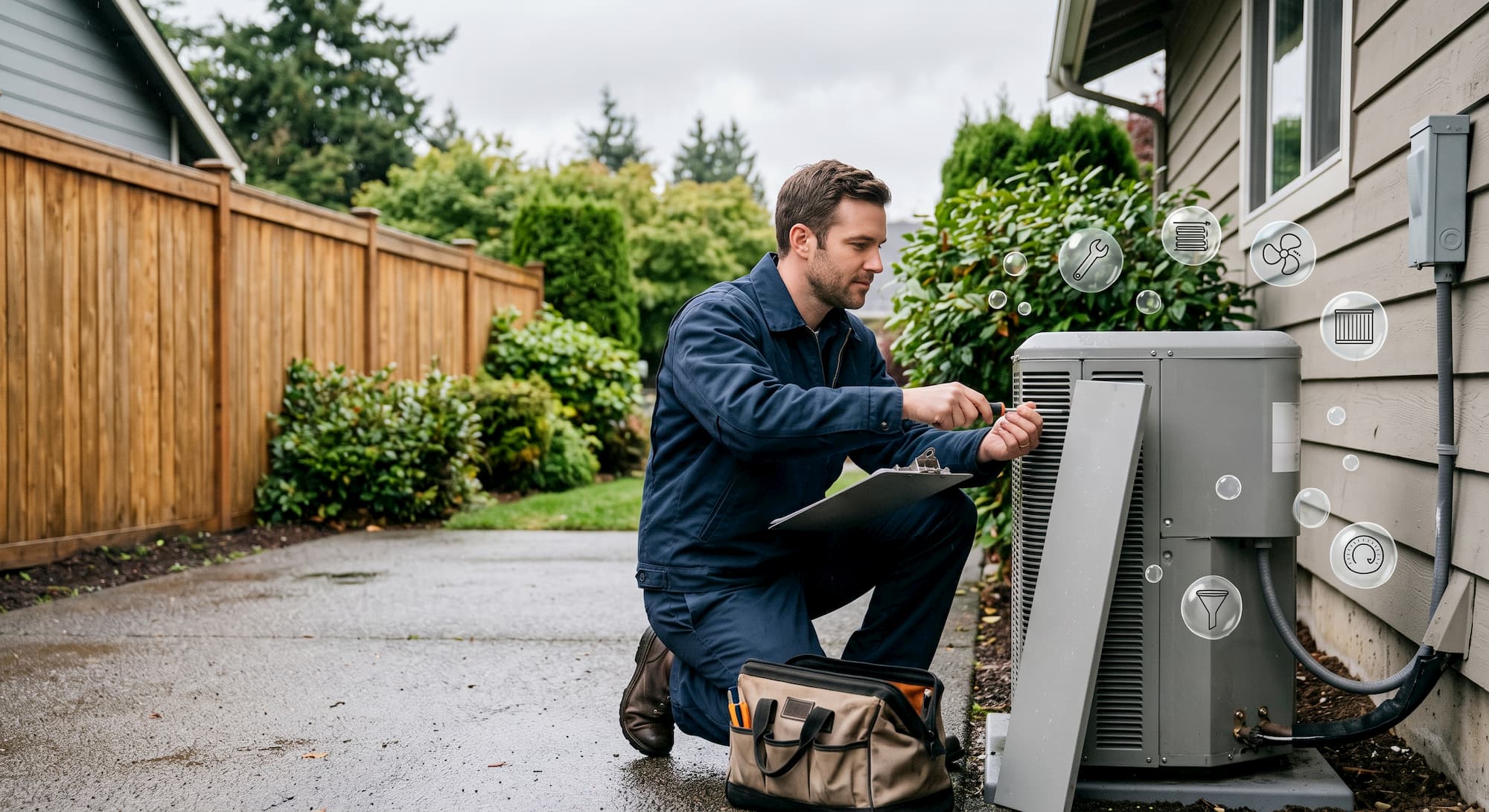
Step 4: Clear the Condensate Drain Before It Overflows
Heat pumps do more than heat. They also cool and dehumidify, which means water has to drain somewhere.
During cooling season, the indoor coil removes moisture from the air. During heating season, the outdoor unit sheds water during defrost. At year five, look for water staining, musty odours, gurgling sounds, float-switch shutdowns, water pooling near the outdoor unit, or slime in the condensate line.
A blocked drain can turn a maintenance issue into drywall, flooring, or ceiling damage. If you have a ducted system, ask the technician to inspect the drain pan, trap, line slope, and safety switch.
Step 5: Inspect Electrical Connections and Inverter Components
Modern inverter heat pumps are not just compressors and coils. They are high-efficiency electrical systems with control boards, sensors, terminals, capacitors, fan motors, and communication wiring. Over five Lower Mainland winters, those components experience moisture, temperature swings, vibration, defrost cycles, and power events.
Ask whether the technician will inspect line-voltage connections, communication wiring, terminal corrosion, the outdoor control board area, capacitors, motors, disconnect condition, surge protection, and fault history where the system supports diagnostics.
This is not a DIY area. Leave electrical testing to qualified technicians. Homeowner warning signs include intermittent shutdowns, nuisance breaker trips, unusual buzzing, repeated error codes, or a system that behaves differently in wet weather.
Step 6: Test Refrigerant Performance, But Do Not Accept a Blind “Top-Up”
A heat pump does not use up refrigerant like a car uses fuel. It is a sealed system. If refrigerant is low, something is leaking.
That leak might be at a flare joint, coil, service valve, braze joint, or line set. It might show up first as longer heating cycles, weaker cooling, higher bills, frost where it should not appear, or auxiliary heat running more often.
If a technician says the system is low, ask whether airflow, coil condition, temperature readings, pressure readings, superheat or subcooling, and electronic leak detection were checked before refrigerant was added.
Adding refrigerant without finding the leak can temporarily mask the problem while the compressor continues to run under poor conditions. For older systems, the leak conversation should also include repair-versus-replacement math.
Step 7: Watch the Defrost Cycle in Damp Winter Weather
Metro Vancouver winters are mild compared with much of Canada, but they are often damp. Outdoor coils can frost up when the unit extracts heat from cold, wet air. A working heat pump periodically enters defrost mode to clear the coil.
Some defrost activity is normal. Constant or incomplete defrost is not.
Warning signs include heavy ice that does not clear, constant defrost, weaker heating on 0°C to 4°C mornings, backup heat running more often, refreezing water, or poor drainage around the outdoor unit.
Ask your technician to verify sensor readings, defrost operation, outdoor coil condition, and drainage. If your outdoor unit sits on a low pad in a wet area, also ask whether it should be raised or better protected from pooling water.
Step 8: Compare Your Energy Bills Against Last Year
Your hydro bill can catch problems before your thermostat does. Pull the last 12 to 24 months of electricity usage and compare similar months. If winter usage rose even though thermostat settings stayed the same, possible causes include dirty coils, refrigerant loss, backup electric heat, control changes, duct leakage, airflow restrictions, or a failing component.
Do not panic over one high bill during an unusually cold stretch. Look for a sustained change. A healthy heat pump should not quietly slide into expensive backup heat without a reason.
The Year-5 Heat Pump Rebate Maintenance Checklist
Use this table before booking service.
| Area | What to Check | Why It Matters |
|---|---|---|
| Warranty records | Invoice, serial numbers, model numbers, service reports | Helps avoid confusion if a part fails |
| Outdoor coil | Dirt, salt exposure, debris, fin damage | Protects airflow and efficiency |
| Indoor airflow | Filters, vents, duct restrictions, fan wheel buildup | Prevents poor comfort and compressor strain |
| Condensate drain | Drain pan, trap, slope, slime, float switch | Reduces water damage risk |
| Electrical system | Terminals, boards, capacitors, disconnect, surge protection | Catches intermittent failures early |
| Refrigerant circuit | Pressures, temperatures, leak detection | Avoids blind top-ups and repeat failures |
| Defrost operation | Frost clearing, drainage, sensor performance | Critical in damp coastal winters |
| Energy use | Compare similar months year over year | Flags hidden efficiency losses |
Should You Repair or Replace a Five- to Eight-Year-Old Heat Pump?
Most five-year-old heat pumps should be repaired and maintained, not replaced.
A clogged drain, dirty coil, failed sensor, weak capacitor, or control setting issue is usually a repair conversation. A major coil leak, repeated board failures, compressor damage, or poor original sizing deserves a bigger discussion.
Ask whether the equipment is still under parts warranty, whether labour is covered, whether failures are repeating, whether the original installation was sized and commissioned properly, and whether a repair would restore reliable service or only buy time.
As of 2026, BC rebate programs have changed from the 2018-2021 period. Better Homes BC now separates several offers, including income-qualified Energy Savings Program rebates and Home Renovation Rebate Program offers. BC Hydro also lists current heat pump rebate and bonus rebate details that can change by date and funding availability. If replacement is on the table, check current rebate rules before signing anything.
A Note for Bosch, Mitsubishi, Daikin, Fujitsu, Carrier, and Other Owners
Homeowners often search by brand when something goes wrong: “Bosch heat pump problem,” “Mitsubishi warranty,” “Daikin leak,” or “Fujitsu not heating.” That is understandable, but it can lead to bad conclusions.
Without verified service data, it is not fair or useful to claim that one brand is failing across Richmond or Metro Vancouver. What we can say is more practical: all inverter heat pumps need clean airflow, correct sizing, good installation, proper drainage, stable electrical connections, and accurate diagnosis.
Brand matters. Installation and maintenance matter just as much. If you own a Bosch IDS, Mitsubishi, Daikin, Fujitsu, Carrier, Lennox, LG, Samsung, Gree, or another rebate-era heat pump, use the same year-five checklist and verify model-specific warranty requirements.
FAQ: Heat Pump Rebate Maintenance in BC
How Long Should an Air-Source Heat Pump Last in Metro Vancouver?
Natural Resources Canada lists air-source heat pumps at roughly 15 to 20 years of service life. Actual lifespan depends on installation quality, maintenance, usage, coastal exposure, airflow, and whether small issues are fixed before they damage major components.
Is Coastal Air Really a Problem for Heat Pumps in Richmond and Vancouver?
It can be. Coastal corrosion depends on distance from salt water, wind, humidity, coil temperature, and local exposure. Not every home has the same risk, but outdoor coils and electrical connections should be inspected regularly in coastal Lower Mainland communities.
Does My Heat Pump Warranty Depend on Registration?
It depends on the manufacturer and product. Bosch Canada states that registration does not affect warranty eligibility, but other brands and product lines may have different terms. Always check the exact warranty document for your model and keep maintenance records.
Should Refrigerant Ever Be Topped Up?
Only after proper diagnosis. A heat pump is a sealed system, so low refrigerant usually means a leak. Ask for leak detection and documentation before paying for refrigerant. A blind top-up can hide the real problem and lead to repeat service calls.
What Can Homeowners Safely Do Themselves?
Most homeowners can clean or replace filters, keep vents open, clear debris around the outdoor unit, watch for water leaks, and track energy use. Leave electrical testing, refrigerant work, coil disassembly, and internal diagnostics to qualified technicians.
This Week: Protect the System You Already Paid For
The rebate helped with the purchase. Maintenance protects the investment.
This week, do three things:
- Find your heat pump paperwork and warranty records.
- Walk around the indoor and outdoor units with this checklist.
- Book a proper service visit if the system has not had documented maintenance in the last year.
If the system is working well, year-five maintenance helps keep it that way. If something is starting to drift, catching it early gives you better options.
West Coast Geothermal helps Lower Mainland homeowners think beyond quick fixes: comfort, reliability, energy independence, and long-term system value. If your heat pump is aging, underperforming, or making you question whether repair or replacement is the smarter move, contact our Vancouver team for practical guidance.