
Spring Geothermal Faults in BC: What Those Flashing Lights Really Mean (And When to Call)
March 7, 2026
Spring in British Columbia is beautiful — unless your geothermal system decides to announce the season change with a flashing red light and a “Call for Service” message at 7 AM on a Monday.
Every spring, West Coast Geothermal receives a surge of service calls from homeowners in Vancouver, Burnaby, Surrey, Langley, Abbotsford, and across the Fraser Valley — all triggered by the same seasonal event: the heating-to-cooling transition. Most of these calls are preventable. Some aren’t. And knowing the difference is what separates an anxious morning from a simple fix you can handle before breakfast.
This guide covers the most common WaterFurnace fault codes that appear during the spring switchover, three diagnostic steps you can take before calling a technician, and why geothermal systems require a fundamentally different repair approach than standard HVAC. We’ve also included a full FAQ section at the bottom — because the questions we get asked most often deserve straight answers.
Why the Heating-to-Cooling Transition Is Hard on Geothermal Systems
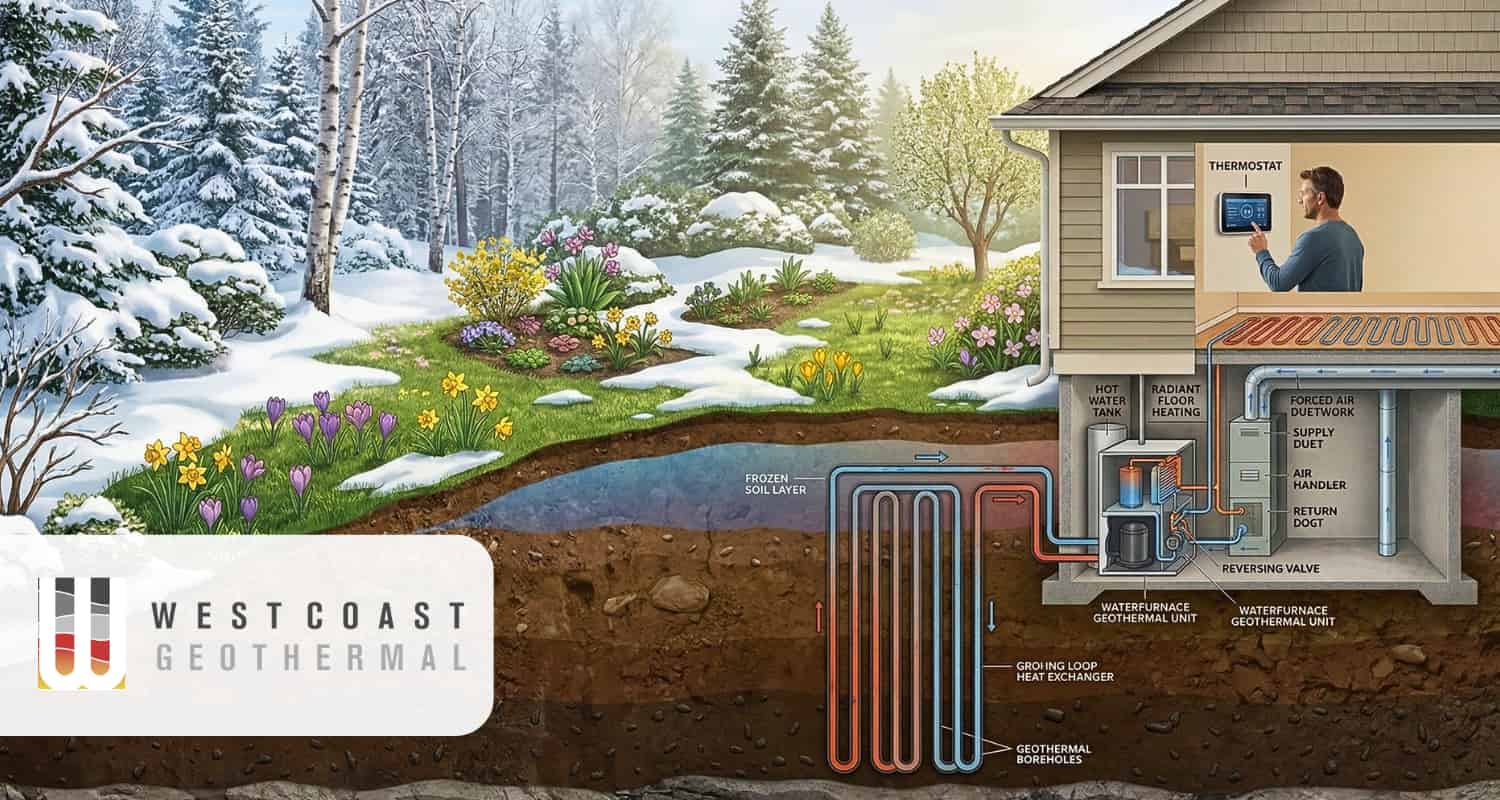
Your geothermal heat pump doesn’t just “switch on cooling” the way a window AC unit does. It reverses the entire direction of refrigerant flow through a precision-engineered closed loop. That reversal — managed by a reversing valve — places momentary stress on every component in the system simultaneously: the compressor, water coil, blower motor, and control board sensors all receive a new set of operating parameters at once.
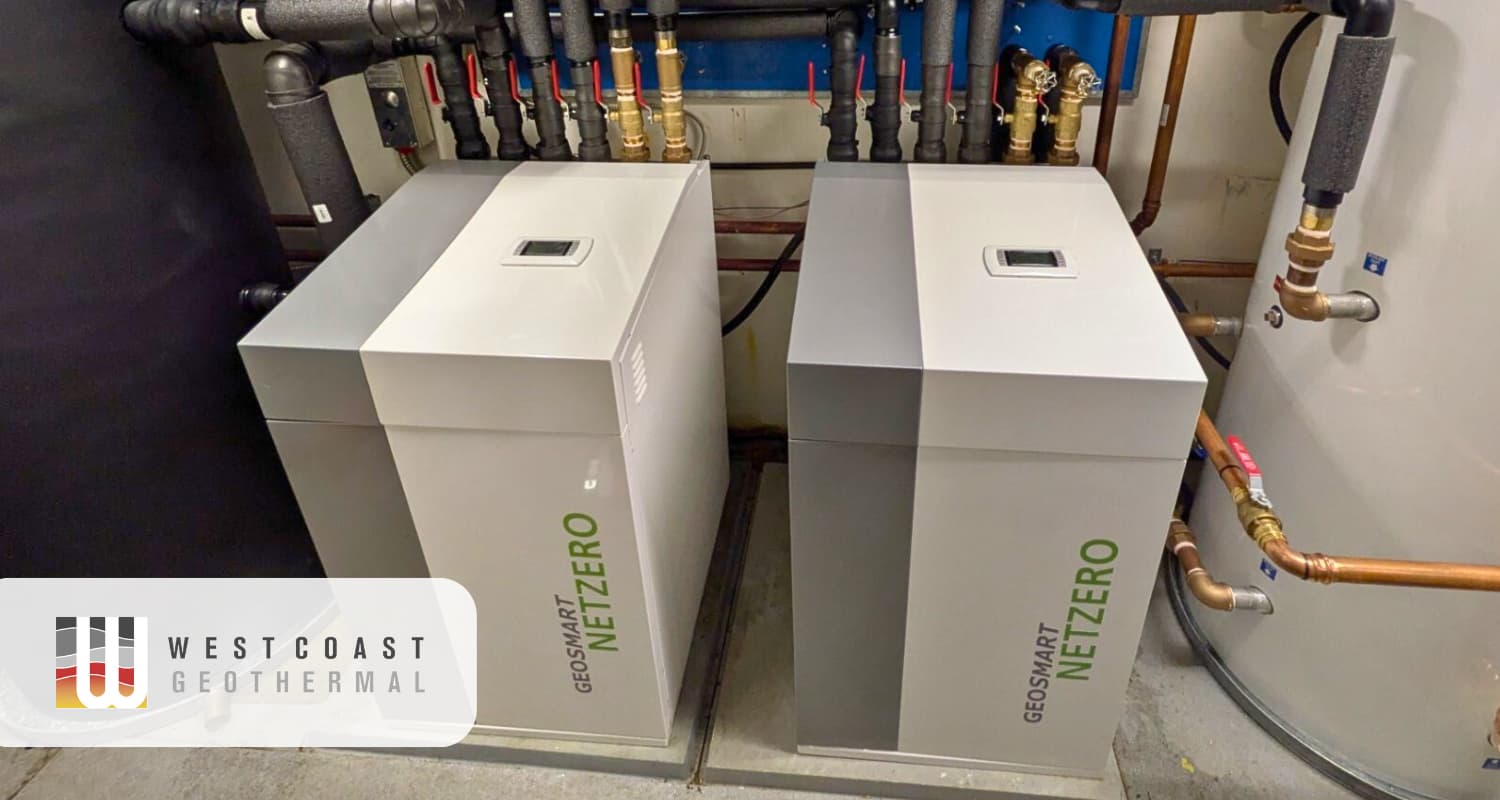
In the Lower Mainland and Fraser Valley, this transition typically occurs between late March and early May, when outdoor temperatures fluctuate enough that the system moves in and out of heating mode multiple times in a single week. That cycling stress is exactly when “silent” issues — slightly restricted water flow, a filter that hasn’t been changed since January, a loose sensor connection — stop being silent.
The Most Vulnerable Components During Switchover
- Reversing valve — the mechanical valve that redirects refrigerant flow; any sticking or partial failure shows up here first
- Water coil (ground loop heat exchanger) — restricted flow from winter sediment or air pockets triggers low-pressure faults
- ECM blower motor — electronic commutator motors that power your air handler can fail to re-engage after a mode switch
- High-pressure protection circuit — designed to shut the compressor down before it overheats; one of the most commonly triggered codes in commercial buildings during warm spring days
Common Spring Fault Codes on WaterFurnace Systems in BC
WaterFurnace units communicate faults through LED flash sequences and digital codes on the thermostat display. Here are the three most common codes our technicians diagnose in the Lower Mainland and Fraser Valley each spring.
⚠ FP1 — Low Water Coil Limit Lockout (5 Red Flashes)
What it means: The water coil temperature sensor has detected that the temperature entering or leaving the ground loop heat exchanger has dropped below the safe operating threshold. The unit locks out to protect the compressor.
What triggers it in spring: FP1 is particularly common during the heating-to-cooling transition because winter can leave residual air pockets in the loop system, or partially restrict the circulator pump output. When the unit attempts its first cooling cycle and demands full water flow, restricted circulation causes a rapid temperature drop — and FP1 fires.
What you’ll see: Red LED flashing 5 times repeatedly, with the system locked out. The thermostat may display “Call for Service.”
What it is NOT: FP1 is not always a refrigerant leak. Before assuming the worst, complete the three diagnostic steps in the next section.
⚠ Code 10 / ECM Airflow Fault — Blower Motor Not Engaging
What it means: The electronically commutated motor (ECM) that drives your air handler blower is receiving power signal from the control board but failing to start or sustain operation. This is an airflow fault, not a refrigerant fault.
What triggers it in spring: ECM motors in WaterFurnace units can develop soft failures over winter when the system runs predominantly in single-stage heating mode. The full-speed demand of first-stage cooling operation exposes those failures. You may hear a brief whirring or clicking sound from the air handler, followed by silence — and no air from your registers.
What you’ll see: Blower starts briefly then stops, or doesn’t start at all. The system may short-cycle. Vents produce no airflow even when the thermostat is calling for cooling.
What to check first: A severely clogged air filter can trigger an ECM fault as the motor overloads trying to push air through the restriction. This is the first thing to check (see Step 1 below).
⚠ HPF — High Pressure Fault (Compressor Protection Lockout)
What it means: The high-pressure safety switch has detected that refrigerant pressure inside the compressor circuit has exceeded the safe operating limit. The unit de-energizes the compressor to prevent mechanical damage — this is the system working correctly, not failing.
What triggers it in spring: On warm spring days, especially in multi-unit or commercial buildings like strata complexes and mixed-use buildings in the Lower Mainland, the condenser-side of the system can become heat-saturated if water flow is restricted or if the unit is oversized relative to the load. The compressor builds pressure faster than the loop can dissipate it.
What you’ll see: The system starts a cooling cycle and shuts down within a few minutes. Red lockout light. The fault often clears briefly after a manual reset, then returns on the next cooling demand.
Important: Repeated HPF lockouts without diagnosis can cause compressor wear over time. If your unit is resetting and relocking repeatedly, this requires professional evaluation — book a service call with our certified technicians before it escalates.
Three Steps to Take Before Calling a Technician
These three checks should take 15–30 minutes and resolve roughly 20–30% of spring fault calls — no tools required beyond a flashlight and your breaker panel.
Step 1: Check and Replace the Air Filter
A clogged air filter is the single most common cause of ECM airflow faults and contributes to both FP1 and HPF events by reducing airflow across the heat exchanger.
Where to find it: Typically at the air handler unit or in a return air grille. Common WaterFurnace filter sizes include 9.625″ × 17.625″ × 1″ and 27.75″ × 27.75″ — check your unit’s access panel label for the correct size.
Rule of thumb: If you haven’t changed the filter since before Christmas, change it now before anything else. A quality 1-inch pleated filter should be replaced every 60–90 days during heavy-use seasons.
Step 2: Inspect the Circuit Breakers
High-performance units like the WaterFurnace 7 Series draw significant amperage on startup — particularly during the first cooling cycle of the season after months of heating-mode operation. A breaker that’s been “soft-tripping” (appearing set, but not delivering full current) can cause erratic fault codes without showing as clearly tripped.
What to do: At your main panel, locate the breaker dedicated to the geothermal unit. Turn it fully OFF, wait 30 seconds, then turn it fully ON. Check for any other tripped breakers in the same zone. Do not repeatedly reset a breaker that trips again immediately — that indicates an electrical fault requiring a licensed electrician.
Step 3: Perform a “Hard Reset” (24-Hour Thermostat Off Cycle)
Some fault conditions in WaterFurnace systems are triggered by sensor transients — brief anomalous readings that cause the control board to lock out as a precaution, even when no actual fault exists. A full 24-hour shutdown allows sensors to recalibrate to ambient conditions.
How to do it: Set the thermostat to “Off” (not just to a setpoint you won’t reach — actually Off). Leave it off for a minimum of 2 hours; 24 hours is ideal for persistent faults. Then restart the system in cooling mode and observe whether the fault recurs within the first 10 minutes of operation.
Important: If the fault code returns within one cooling cycle after a full reset, this is a genuine fault — not a sensor transient. At this point, the diagnostic requires specialized tools and a certified technician.
Why Geothermal Repair Requires Specialized Expertise
This distinction matters more than most homeowners realize before they receive their second repair bill from a general HVAC contractor.
A conventional forced-air furnace or split-system air conditioner is, relatively speaking, a standardized mechanical system. Any licensed HVAC technician with basic refrigerant certification can diagnose and repair most common faults. Geothermal systems are a different category entirely.
What General HVAC Contractors Often Miss on Geothermal Systems
- Closed-loop coolant testing: The ground loop contains a water-antifreeze mixture (typically propylene glycol in BC applications) that must be tested for pH, freeze protection level, and inhibitor concentration. Most general HVAC technicians don’t carry this equipment.
- Refrigerant conversion protocols: WaterFurnace systems use specific refrigerant types (R-410A in most current units; R-454B in newer models). Cross-contamination during servicing by technicians unfamiliar with geothermal refrigerant circuits is a documented cause of repeat failures.
- ECM motor programming: Replacing an ECM blower motor on a WaterFurnace unit requires programming the replacement module to match the system’s airflow specifications. An unprogrammed or incorrectly programmed ECM module will trigger the same fault codes it was installed to fix.
- Loop pressure and flow diagnostics: Diagnosing FP1 and HPF faults correctly requires a flow meter and pressure gauge on the loop — standard geothermal diagnostic equipment that general contractors rarely carry.
At West Coast Geothermal, our technicians hold CGC, TECA, and ITA certifications specific to geothermal systems — not just general HVAC licenses. We are Canada’s largest WaterFurnace dealer west of Manitoba, which means we have direct access to technical support, parts, and engineering resources that independent contractors don’t. When we diagnose a fault, we’re engineering a solution — not guessing and replacing parts until the problem goes away.
Book a Geothermal Service Call →
Frequently Asked Questions — Geothermal Spring Faults in BC
The questions we get most often from Lower Mainland and Fraser Valley homeowners each spring.
My thermostat says “Call for Service” but the system ran fine all winter. What happened?
The most common explanation is a transition-triggered fault — an issue that was marginal during heating mode but became a problem the moment the system reversed to cooling. Common culprits are restricted water flow in the ground loop, a dirty filter that was manageable in heating mode but fails the airflow test in cooling mode, or a sensor that drifted slightly over winter. Start with the three diagnostic steps above. If the code returns after a full reset, book a service call — transition faults rarely self-resolve and tend to worsen with repeated cycling.
How long should a hard reset take? Can I just flip the breaker?
We recommend using the thermostat Off setting rather than the breaker for routine resets, as a breaker cycle can occasionally cause a voltage spike to control board components. Leave the system off for at least 2 hours for a standard reset; 24 hours if the fault code has been occurring repeatedly. A breaker reset is appropriate when you’re specifically checking whether a breaker has soft-tripped, as described in Step 2 above — but use it as a one-time diagnostic, not a routine fault-clearing method.
Can a regular HVAC company work on my WaterFurnace geothermal system?
Technically, any licensed refrigeration mechanic (Gas B ticket or equivalent) can work on the refrigerant circuit of a geothermal unit. Practically, geothermal-specific diagnostics — loop pressure testing, ECM motor programming, closed-loop coolant analysis — require training and equipment that most general HVAC contractors don’t have. Misdiagnosis by a non-specialist is one of the most common causes of repeat geothermal service calls. For warranty protection on WaterFurnace units, repairs should also be performed by an authorized dealer or certified technician to avoid voiding coverage.
How often should a geothermal system be professionally serviced in BC?
We recommend an annual professional service visit — ideally in late winter (February–March) before the spring transition, or in early fall before the first heating demand of the season. This timing allows a technician to catch issues before they become emergency calls. The service should include loop fluid testing, refrigerant pressure verification, filter inspection, ECM motor current testing, and thermostat calibration check. Homeowners should also replace air filters every 60–90 days independently of scheduled service visits.
My WaterFurnace unit is making a clicking noise but no air is coming out. Is that the ECM fault?
Almost certainly, yes. The clicking or brief whirring sound you hear is the ECM blower motor attempting to start and failing to sustain rotation — a classic Code 10 / ECM airflow fault presentation. The most common cause is a clogged air filter (check this first), followed by a capacitor failure or a failed ECM motor module. Do not continue running the system if the motor is failing to start — sustained failed-start attempts can damage the motor winding and turn a $300 capacitor replacement into a $1,200+ motor swap.
What BC government rebates are available for geothermal system upgrades in 2025?
The CleanBC Better Homes Energy Savings Program currently offers income-qualified BC homeowners up to $24,500 toward eligible heat pump installations. The standard CleanBC Better Homes and Home Renovation Rebate Program offers up to $4,000 for homeowners converting from electric resistance heating. Additional rebates are available through BC Hydro and FortisBC. Note that some fuel-switching rebates ended in April 2025, so eligibility depends on your heating system type and timeline. West Coast Geothermal is an HPCN-eligible contractor — see our complete rebate guide for current details and to find out what you qualify for.
Is it normal for a geothermal system to be noisy during the spring transition?
Some audible change during the first cooling cycle of the season is normal — you may hear the reversing valve shift (a brief swooshing sound), followed by a slight change in compressor tone as the system adapts to cooling mode operation. What is not normal: clicking that repeats without the system engaging, a sustained high-pitched whine from the air handler, gurgling sounds from the loop piping, or any metallic grinding. These are indicators of a real fault. If you’re unsure whether what you’re hearing is within normal range, record a short audio or video clip and send it to our service team — we can often triage remotely.
Spring fault? Let’s sort it out.
West Coast Geothermal serves Vancouver, Richmond, Burnaby, Surrey, Langley, Abbotsford, and the full Fraser Valley. Our CGC, TECA, and ITA-certified technicians specialize in WaterFurnace and ClimateMaster systems — we carry the diagnostic tools and parts general contractors don’t.
This guide was prepared by the technical team at West Coast Geothermal — British Columbia’s largest WaterFurnace dealer west of Manitoba, with 20+ years of geothermal installation and service experience across the Lower Mainland and Fraser Valley. While these steps are appropriate for homeowner diagnostics, all refrigerant work, electrical repairs, and loop system interventions must be performed by a licensed, certified technician. For questions about your specific system, contact our team directly.