
The EV Revolution for Your Home - Geothermal Heating in the Lower Mainland
February 15, 2026
Across Vancouver, the Fraser Valley, and the Lower Mainland, homeowners are electrifying — moving away from fossil fuels and toward smarter, cleaner home comfort.
Geothermal heating is quickly becoming the premium choice for those who want long-term efficiency, quiet operation, and stable operating costs.
From electric vehicles to high-performance building standards, the shift to electrification is accelerating in British Columbia.
And now, that transformation is happening inside the home.
Geothermal heating — also called geoexchange — delivers consistent year-round comfort by using stable underground temperatures as its energy source.
This isn’t just a mechanical upgrade. It’s the EV revolution for your home.
Why homeowners are switching
- Up to 60–70% lower heating/cooling energy use (vs. conventional systems)
- Quiet, steady comfort with fewer temperature swings
- A safer, “flameless” home (no combustion on-site)
- Long-term infrastructure value (loops can last 50+ years)
Electrification Is Accelerating Across the Lower Mainland
Whether you’re in Vancouver, Burnaby, Surrey, Coquitlam, Langley, Abbotsford, or Chilliwack, the conversation has changed.
Homeowners are increasingly asking:
Homeowners Across the Lower Mainland Are Asking:
- How do I reduce reliance on natural gas?
- How do I future-proof my home?
- What heating system makes sense long term?
Air-source heat pumps are now common, but for homeowners looking for maximum efficiency and stable performance year-round,
Geothermal stands apart as a premium electrification solution.
What Makes Geothermal Heating Different?
Traditional furnaces generate heat by burning fuel.
That means combustion byproducts, fluctuating costs, and efficiency limits.
Geothermal systems do something smarter:
Geothermal moves heat instead of creating it.
Just a few hundred feet underground throughout the Lower Mainland and Fraser Valley, temperatures remain stable year-round.
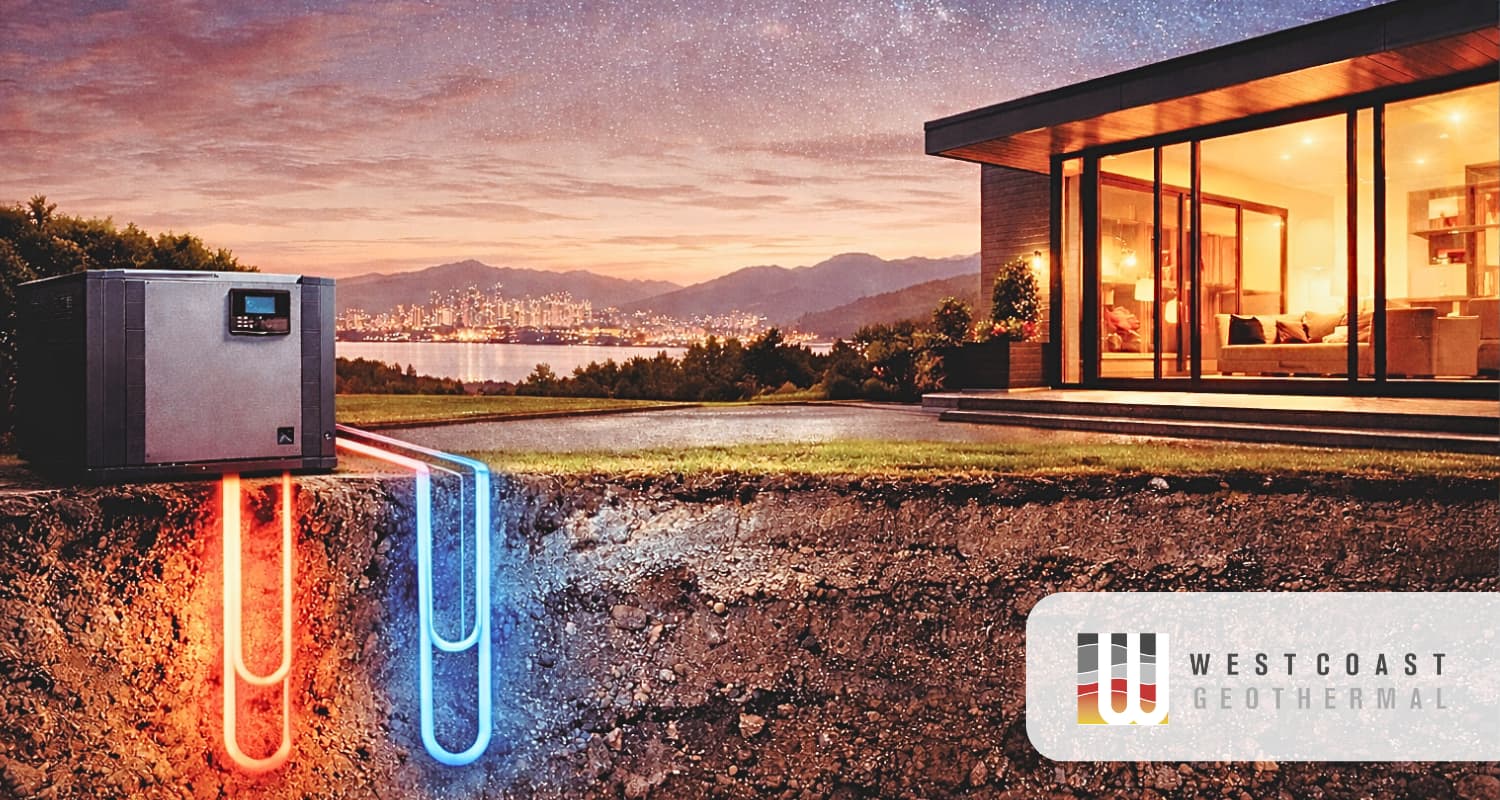
A closed-loop system circulates fluid through underground piping, acting as a heat exchanger:
Winter heating
Heat is drawn from the ground and transferred into your home.
Summer cooling
Heat is removed from your home and rejected back into the cooler earth.
Because geothermal transfers energy rather than generating it through combustion, it can deliver
four to five units of heating or cooling for every one unit of electricity used.
That can translate into up to 60–70% lower heating and cooling energy consumption compared to conventional systems.
The Comfort Difference Homeowners Notice Immediately
Electrification isn’t just about efficiency. It’s also about a better day-to-day experience — quieter, steadier comfort with fewer swings.
Even, consistent temperatures
Modern geothermal systems can run smoothly and adjust output gradually, reducing noisy cycling and keeping temperatures steady.
Quiet operation
With no outdoor A/C compressor roaring and no burner firing, geothermal is ideal for quiet residential neighbourhoods.
A “flameless” home
No combustion on-site means no carbon monoxide risk, no on-site emissions, and cleaner indoor air.
Why the Lower Mainland Is a Great Fit for Geothermal
Most residential geothermal installations in the region use closed-loop systems that circulate fluid through underground piping.
The design is chosen based on your property size, layout, and local conditions.
Vertical loops
Installed in boreholes — often ideal for tighter city lots in Vancouver, Burnaby, New Westminster, and surrounding areas.
Horizontal loops
Installed in trenches where space allows — common for larger properties in parts of Langley, Abbotsford, and the Fraser Valley.
Each project should be engineered to your home’s heating and cooling load, soil conditions, and mechanical layout —
which is why experienced local design and installation matters.
A Long-Term Infrastructure Investment
A long-term infrastructure upgrade.
Often longer than conventional HVAC equipment.
As energy costs and policies evolve, geothermal offers predictable performance and long-term value.
Incentive programs can improve payback, but availability changes over time. During your assessment,
we can walk you through what programs may apply to your project.
Is Geothermal Right for Your Home?
Lot size, insulation levels, existing ductwork, and energy usage all influence system design.
The first step is a professional site assessment.
Serving Vancouver, the Lower Mainland & Fraser Valley
At West Coast Geothermal, we design and install geothermal heating and cooling systems throughout Vancouver,
the Lower Mainland, and the Fraser Valley. We evaluate your property, design a properly sized system, and manage the installation from drilling to commissioning.
Need help?
Questions about your system or service needs?
Talk to West Coast Geothermal for practical guidance on troubleshooting, service, repair, or replacement options.